
An XAU/USD trade plan is not pressure-tested merely because it contains an entry, stop and target. It becomes reviewable when you challenge the assumptions behind those numbers before capital is exposed.
Gold can encounter changing liquidity, scheduled U.S. economic releases and shifting rate expectations. Pre-trade review cannot remove uncertainty or guarantee an outcome. Its value is more practical: it helps you decide whether the setup, risk and behaviour required by the trade still fit the process you intended to follow.
THE CORE QUESTIONWhat must be true, what could go wrong, and what will I do if it does?
THE FIVE-PART REVIEW
Pressure-test the plan, not your conviction.
Write the thesis and invalidation
Start with a plain-language reason for the trade. Record the market condition you believe is present, the evidence that supports it and the exact condition that makes the idea invalid. An entry without invalidation is only an opinion. Your plan should also state what must happen before entry and when you will abandon the setup if confirmation never arrives.
- What must happen before entry?
- What specifically proves the thesis wrong?
Check the event and session context
Review when the trade may be open. Liquidity and execution conditions can change around session transitions and scheduled announcements. Check the official U.S. Bureau of Labor Statistics release calendar and Federal Reserve meeting calendar for events that overlap your holding period. You are not predicting the news; you are deciding whether exposure through it is permitted by your playbook.
- Which session am I trading?
- Does my plan allow exposure through scheduled data?
Convert the setup into account risk
Calculate position size from the distance between entry and invalidation, then test the result against your account, daily-loss and drawdown limits. Include existing exposure rather than judging the trade in isolation. A risk ceiling is a boundary, not an amount that must be used. If the valid stop requires unacceptable account risk, the correct response may be to reduce size or skip the trade.
- What is the planned maximum loss?
- Does total exposure remain inside my rules?
Model spread, slippage and a delayed exit
A chart-level plan can weaken at execution. Recalculate the trade using a wider spread, a less favourable fill and a delayed exit. The CFTC warns that leverage amplifies both gains and losses in retail forex, so execution friction deserves attention before capital is committed. If a modest change breaks your risk limit, resize, restructure or reject the setup.
- What happens if the fill is worse than planned?
- Does the trade survive wider costs?
Pre-commit the adverse scenario and review
Describe the path you do not want: immediate invalidation, a false break, no follow-through or an extended hold. State which actions are allowed after entry and which are prohibited, such as widening a stop or adding unplanned risk. After the trade, grade adherence separately from profit and loss. One profitable outcome does not automatically prove that the decision process was sound.
- What is the adverse path?
- How will I review process quality after the outcome?
XAU/USD PRE-TRADE CHECKLIST
Five checks before capital.
Save or cite this checklist when building your own trading plan. A “no” identifies where the setup needs clarification, resizing or a deliberate decision to wait.
- 01
Thesis, trigger and invalidation are written clearly.
- 02
Session, scheduled events and holding period are checked.
- 03
Position size fits account and drawdown rules.
- 04
Spread widening and a less favourable fill are modelled.
- 05
Adverse scenario, permitted actions and review rules are recorded.
HOW TRAXAU SUPPORTS THE PROCESS
One plan. Seven specialist perspectives.
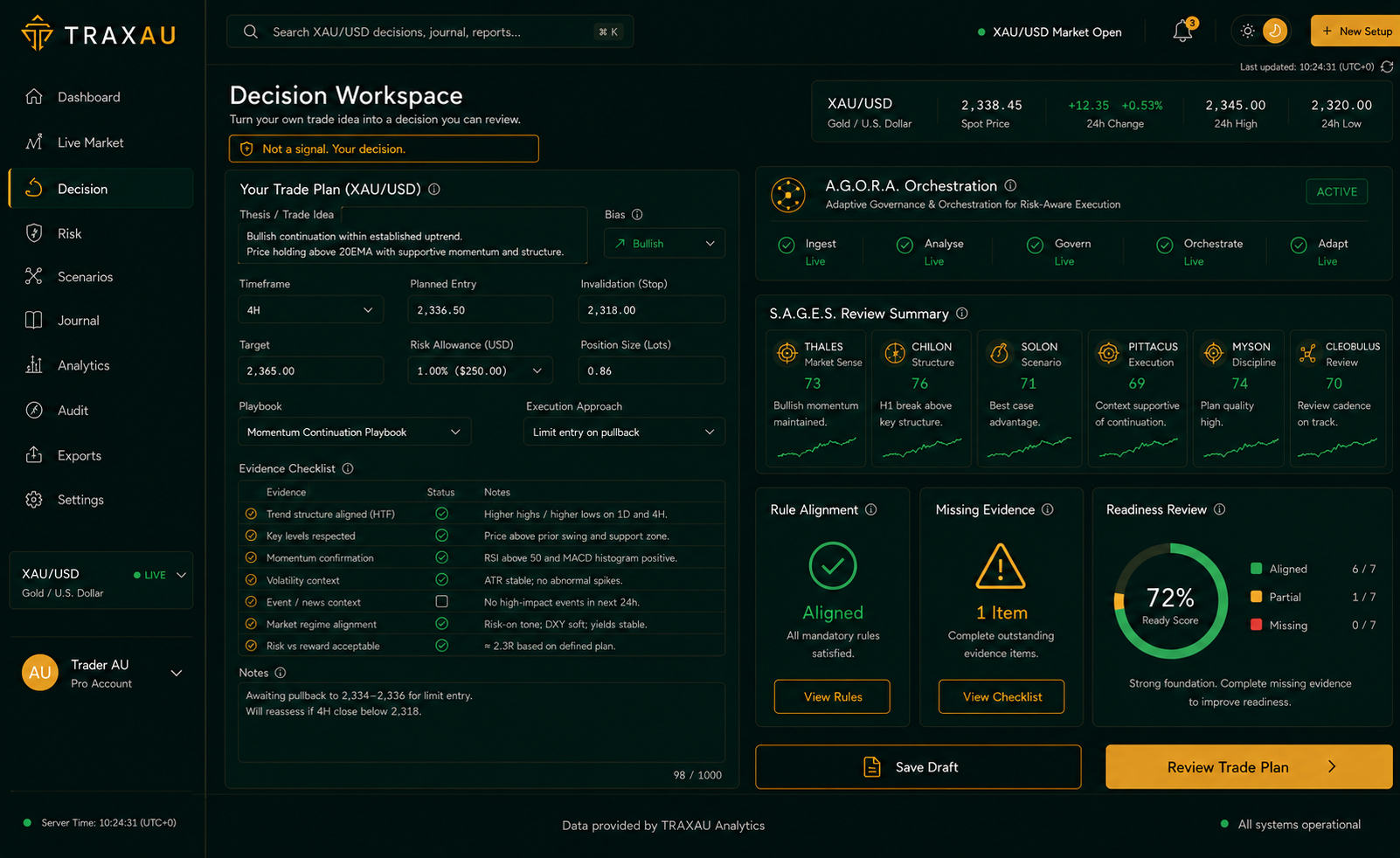
A.G.O.R.A. organises the trader’s own XAU/USD idea into a structured review. The seven S.A.G.E.S. examine context, the risk environment, the risk plan, adverse scenarios, decision conditions, journal quality, and behaviour and learning.
TRAXAU does not originate the trade or tell you to buy or sell. It makes the reasoning easier to examine before the outcome can distort your memory of what was planned.
THE TAKEAWAY
Challenge the trade while walking away is still free.
A pressure-test will not make the market predictable. It can make your exposure intentional. When the thesis, limits, execution assumptions and failure paths are recorded in advance, you have a decision that can be reviewed—regardless of the eventual P&L.
Bring your trade idea.
Build a process you can review.
Use the TRAXAU FREE plan to structure your XAU/USD journal and begin connecting decisions with outcomes.
Authoritative planning references
These outbound sources support event planning and risk awareness. Third-party websites do not endorse TRAXAU.